


100% Profit Donated
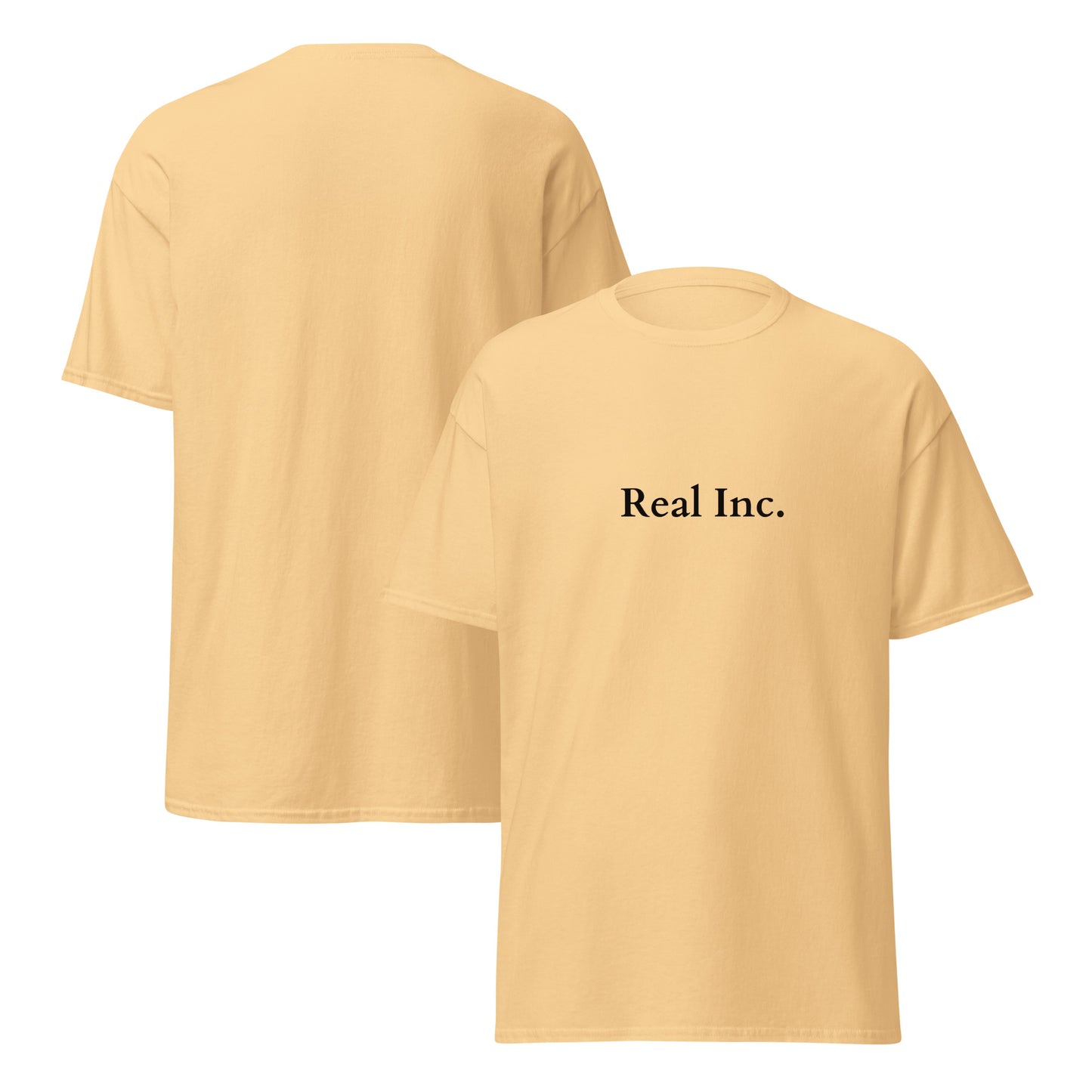
Unisex Classic T-Shirt (Black Font)
Unisex Classic T-Shirt (Black Font)
Couldn't load pickup availability
- Save The World By Shopping
- 100% Of Profit To Charity
- Actual Amounts Of Charitable Acts
The 100% cotton unisex classic tee will help you land a more structured look. It sits nicely, maintains sharp lines around the edges, and goes perfectly with layered streetwear outfits. Plus, it's extra trendy now!
• 100% cotton
• Sport Grey is 90% cotton, 10% polyester
• Ash Grey is 99% cotton, 1% polyester
• Heather colors are 50% cotton, 50% polyester
• Fabric weight: 5.0–5.3 oz/yd² (170-180 g/m²)
• Open-end yarn
• Tubular fabric
• Taped neck and shoulders
• Double seam at sleeves and bottom hem
• Blank product sourced from Honduras, Nicaragua, Haiti, Dominican Republic, Bangladesh, Mexico
Disclaimers:
• Due to the fabric properties, the White color variant may appear off-white rather than bright white.
• Dark color speckles throughout the fabric are expected for the color Natural.
• Traceability:
- Knitting—Honduras, the Dominican Republic
- Dyeing—Honduras, the Dominican Republic
- Manufacturing—Nicaragua, Honduras, Haiti, El Salvador, or the Dominican Republic
• Contains 0% recycled polyester
• Contains 0% dangerous substances
Age restrictions: For adults
EU Warranty: 2 years
Other compliance information: Meets the flammability, lead, cadmium, phthalates and formaldehyde level requirements.
In compliance with the General Product Safety Regulation (GPSR), Real Inc. and SINDEN VENTURES LIMITED ensure that all consumer products offered are safe and meet EU standards. For any product safety related inquiries or concerns, please contact our EU representative at gpsr@sindenventures.com. You can also write to us at Talmud Bavli 70, Beit Shemesh, Israel or Markou Evgenikou 11, Mesa Geitonia, 4002, Limassol, Cyprus.
Size guide
| LENGTH (inches) | WIDTH (inches) | SLEEVE LENGTH (inches) | |
| S | 28 | 18 | 15 ⅝ |
| M | 29 | 20 | 17 |
| L | 30 | 22 | 18 ½ |
| XL | 31 | 24 | 20 |
| 2XL | 32 | 26 | 21 ½ |
| 3XL | 33 | 28 | 22 ¾ |
| 4XL | 34 | 30 | 24 ¼ |
| 5XL | 35 | 32 | 25 ¼ |
| LENGTH (cm) | WIDTH (cm) | SLEEVE LENGTH (cm) | |
| S | 71.1 | 45.7 | 39.7 |
| M | 73.7 | 50.8 | 43.2 |
| L | 76.2 | 55.9 | 47 |
| XL | 78.7 | 61 | 50.8 |
| 2XL | 81.3 | 66 | 54.6 |
| 3XL | 83.8 | 71.1 | 58 |
| 4XL | 86.4 | 76.2 | 61.5 |
| 5XL | 89 | 81.3 | 64.3 |


General Information
Shipping
In many ways saving the world costs money including putting an end to human suffering. Money doesn't just make the world go round it can also make it go around in the right direction.
Dan Pallotta, a charity researcher and spokesman, is known for the concept that charities could actually eliminate the problems they were set out to do if they actually made enough money to do it.
Charity costs money. This is not a big surprise but a much needed message when many place high expectations for charities to donate as much of their fundraising as possible instead of using it for say, more fundraising, so that the charity can donate more than before the added fundraising.
A charity with more money can do more charity and the money first has to come from fundraising which also costs money. It takes more dough to make a bigger pie but you can share more of that bigger pie.
The funds charities gather from fundraising is from the profit made during transactions. Real Economics is going straight to the source of this profit, the transaction, and allocating some of the profit from that transaction to real (apparent) amounts of charity towards solving the Real Problem.
The Real Problem states that only when all possible courses of action are directly in front of us do we know which actions are most important by knowing which we would tend to first and this would be apparent human suffering.
In other words, the realness or truth of reality is revealed to us only when it's right in front of us. In this sense, Real Economics is the most important form of economics because it is the most important thing that economics can do: end human suffering.
Returns
Real Economics Incorporated or Real Inc. for short is the incorporation of Real Economics in the world, putting it into practice, selling products and services and then donating the profit (all of it) to real amounts of charitable acts, namely the ending of human suffering.
Real Inc. is supposed to be the initial example and template for other companies to have an idea of how to integrate Real Economics into their own operation.
On our roadmap and hopefully soon in our pipeline is a service that will automate this integration into a company’s backend financials and onto their frontend for customers to freely choose donation options as they can do in the Real (Inc.) Store.
Tracking
By first assessing if Real Charity taken from your profits will drive more profits by attracting and retaining customers with the added incentive of Real Charity. If such contributions will harm profits in the end then we advise not doing so. If your company brings in more profits than the company and its owners need then it is advised to direct those excess profits to Real Charity.
Once you assess that it would be valuable for your operation to give to Real Charity it comes down to which charity, who is choosing (you or the customer), and how will funds be properly distributed to such charities.
Donations
Profit is generally revenues paid out to shareholders as dividends (cash payments) after subtracting expenses, investments, cash reserves, etc.. There's only one Real Inc. shareholder and he's more than satisfied with the salary Real Inc. pays him, which is an expense. 100% profit donated simply means 100% of the revenue from a company's revenue streams goes towards maintaining and growing those revenue streams, not a single dollar gets paid out as dividends to the shareholders, and anything that's not used for the company gets donated.
FAQ's
That's what Real Inc. is for. The primary goal of Real Incorporated is to incorporate Real Economics into the world, through whatever moral means necessary, whether through collaborating, convincing, and even competing.
Collaboration such as through affiliation as we do with companies in the Real Plaza. Convincing by educating. And competing by offering customers a way to contribute to solving the problems of their world free of charge. Customers can contribute 100% of the profit from their purchase back to themselves instead of to those they are buying from. It is simply a better way to shop. It is competition by contribution.
It's hard to imagine someone would purchase the same product at a store that doesn't contribute if they can purchase at a store that does. Our contributions are also quantified making them more real, actionable, measurable, trackable, and therefore they can be visualized and therefore more appreciated. We even give the customers the choice as to where the charity should be contributed, from every single product they buy, or they can leave it up to us to decide by leaving the default donation option "Where It's Needed Most."
Ultimately, the goal is to weed out those who don't contribute or convert them under social and market pressures and expectations by establishing a new market standard.
Contact
Real Economics is economics that solves the Real Problem. The Real Problem has two parts to it and government can only help solve the second part but not the first.
The first part of the Real Problem is the tendency to forget that which is not directly in front of us, specifically people who are suffering. The second part is to end that suffering. Part two is the end goal and doesn't require part one but solving both is greater.
Governments can use tax money from the people to contribute to ending suffering but this leaves the people not contributing themselves and the host of benefits contributing provides the one contributing. As well, it doesn't solve the initial problem of this tendency which people must train themselves to eliminate on their own.
While the goal is to end suffering it is by solving this tendency that people will come to solve suffering on their own. This tendency is a primary problem of people that could not be solved if governments didn't allow them to solve it.
The first goal of Real Economics, while not the end goal, is for humanity not to forget about one another and government takes that away. Solving this tendency which is at the heart of humanity's problems will also bring humanity to solve the many environmental problems and other problems that require attention as well.
As long as the issues of humanity and the environment are out of sight, they are also out of mind, and this is the first problem Real Economics seeks to solve by educating people to see these problems with the sight of their mind until it seeps into their hearts and from there affecting their actions.
Furthermore, when we solve this tendency we become a species that not just can end suffering but keep it that way. Whereas if government ended the suffering but then the government itself ended as has happened to many governments throughout history, the suffering is sure to bounce back because we never eliminated our tendency not to tend to the suffering to begin with. Humanity can't mend their problems if they don't first tend to them, and they won't tend to what they have the tendency to forget about. When we remove one of the greatest human flaws of not tending to the suffering we remove humans suffering and one of their greatest flaws of humanity.
All this being said, it ultimately comes down to what we would do if an apparent suffering person were right in front of us and the answer is that nothing else would matter but him. That means that while government would be better of not helping him in order to let the people (learn to) help him, the reality is that if an apparent suffering person were in front of you, you wouldn't run to your friend and say its better you help him as there are benefits in you doing so instead of me, rather you would run to help and shout at your friend to do so as well. Therefore everyone including the government should face this reality and run to end suffering with not a thought otherwise.
Ultimately, when faced with the Real Problem, the government and the people naturally come together to solve it. Religious differences fade away. Orientations become obsolete. Culture matters not. Enemies become friends. Hate loses its place and love sharply comes to the surface. Even the capitalists and the socialists unite to become realists.

Just Launched